

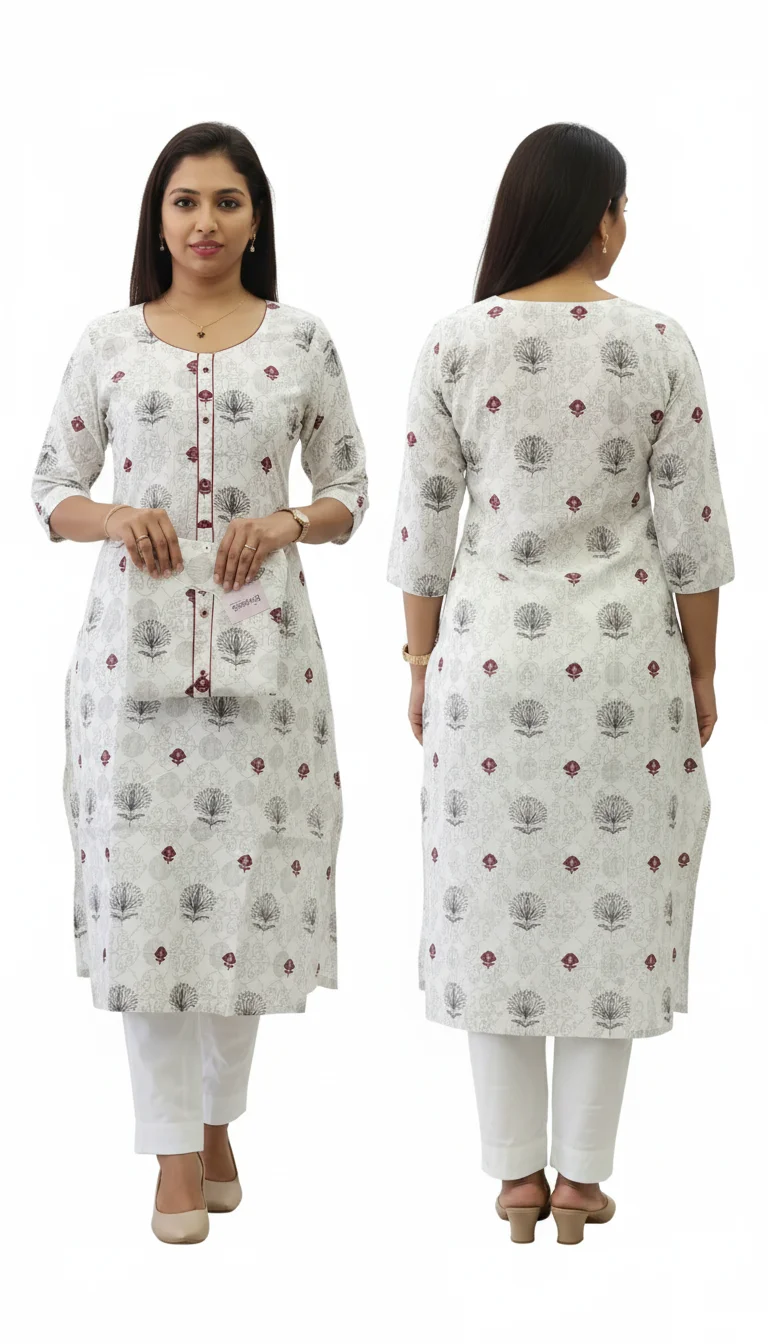

Hand block printing uses carved wooden blocks to stamp patterns onto fabric. Rajasthan is famous for it, and each printing centre has its own style. Here is a quick guide.
How block printing works
Artisans carve designs into wooden blocks, dip them in dye and press them by hand onto fabric. Larger designs may use several blocks, one for each colour. Small misalignments are a sign of real hand printing.
Bagru prints
- From Bagru, a village near Jaipur.
- Earthy colours like rust, black, indigo and mustard.
- Often printed on off-white or natural backgrounds.
- Motifs include small flowers, leaves and geometric shapes.
Sanganeri prints
- From Sanganer, also near Jaipur.
- Finer, more delicate floral motifs on light backgrounds.
- Brighter colours like pink, blue and green.
Dabu prints
- Uses a mud-resist technique: a paste of mud and other materials is printed first, then the fabric is dyed.
- The covered areas stay light, creating a slightly cracked, organic look.
- Often seen in indigo and black.
Ajrakh (a related craft)
Ajrakh from Gujarat and Rajasthan uses resist printing with rich indigo and red, in complex geometric patterns.
Styling a block print A-line kurta
- Office: a Sanganeri print kurta with white straight pants and silver jewellery.
- Weekend: a Bagru print kurta with jeans and kolhapuris.
- Day event: a Dabu indigo kurta with a contrast mustard dupatta.
Spotting hand block prints
- Small gaps or overlaps where the block was placed.
- Slight colour variation from print to print.
- The print often shows through faintly on the reverse.
Care tips
- Wash separately in cold water for the first few washes.
- Use mild detergent and avoid bleach.
- Dry in shade to protect natural dyes.
Common mistakes to avoid
- Washing block prints in hot water. Natural dyes fade faster.
- Expecting perfect symmetry. Small irregularities are part of the handmade charm.
- Using strong detergents. They strip natural dyes.
- Hanging in direct sun. Earthy colours can fade unevenly.
Frequently asked questions
Is block printing done by hand?
Traditional block printing is done by hand with carved wooden blocks. Some fabrics use screen printing to copy the look.
Which block print is best for summer?
Sanganeri prints on light cotton are fresh and cool for summer.
What is the difference between Bagru and Dabu?
Bagru is direct block printing with earthy colours. Dabu uses a mud-resist paste before dyeing, creating a cracked, organic effect.
Do block print colours fade?
Natural dyes can soften over time. Cold washes and drying in shade keep them bright longer.
Can block print kurtas be worn for festivals?
Yes. Choose brighter colours and pair with a festive dupatta and jhumkas.
Styling ideas
- Office: indigo Dabu kurta with white trousers.
- Weekend: Bagru kurta with jeans and silver jewellery.
- Festival: Sanganeri pink kurta with a gota dupatta.
Why choose handmade?
Hand block printing supports artisan communities and keeps traditional crafts alive. Each piece is slightly unique.
Three complete outfit examples
The office day. Wear a Sanganeri block print A-line kurta in soft pink with white straight pants, silver earrings and flats.
The weekend. Choose a Bagru print kurta in rust and black with blue jeans and kolhapuris.
The festive lunch. Pick an indigo Dabu kurta with a mustard dupatta and oxidised jhumkas.
Buying tip
Ask the seller whether the print is hand block or screen printed, and where it was made. Hand block prints often cost a little more, but they last well and support traditional printers.
In short: Bagru is earthy, Sanganeri is delicate and Dabu has a mud-resist look. Each brings handmade charm to an A-line kurta, perfect for work and casual days.