

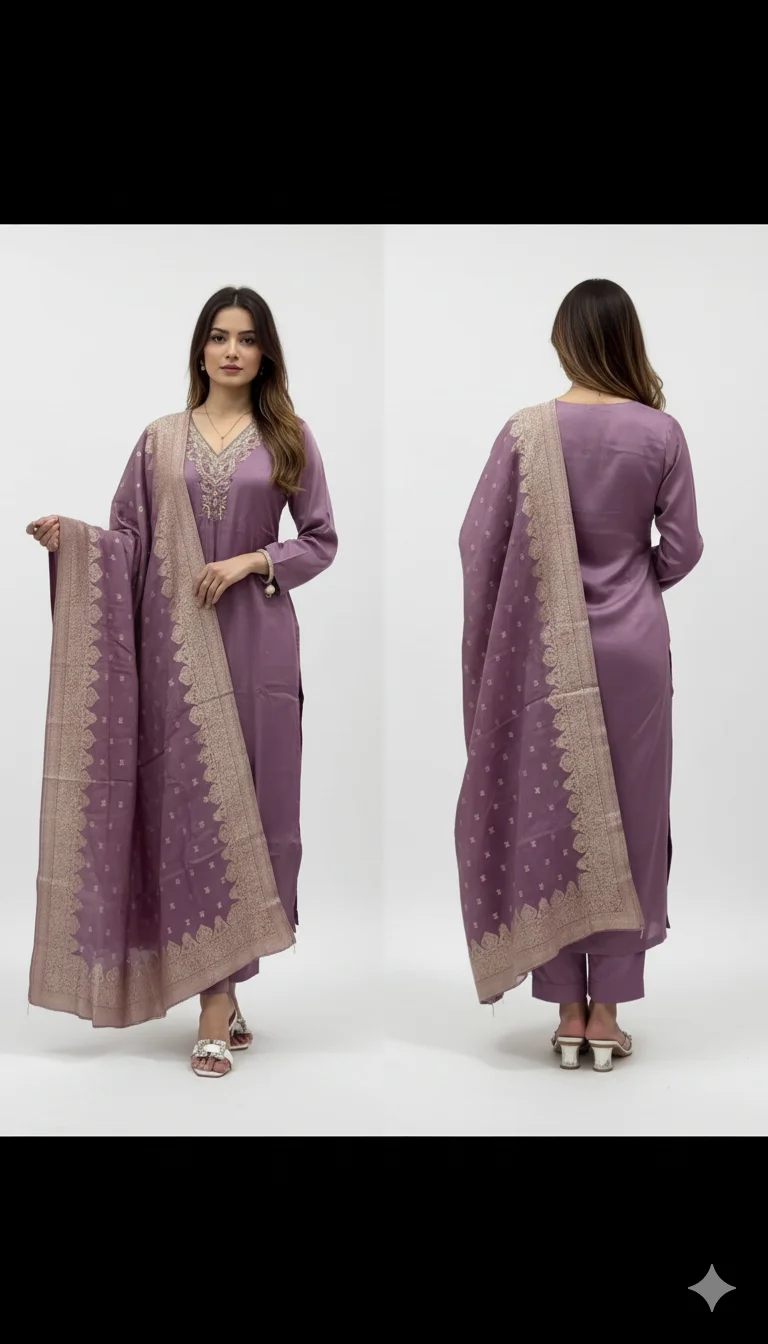

A jacquard dupatta is one of the easiest ways to make a simple kurta set look special. Jacquard is a weaving technique where the pattern is woven into the fabric itself rather than printed on top, so the design has texture and a soft sheen. Here is how to get the most out of one.
1. Let the dupatta be the hero
If your kurta set is plain or has light embroidery, choose a jacquard dupatta with a bold woven border. Keep jewellery small, such as studs or a thin chain, so the dupatta stands out.
2. Classic one-shoulder drape
Pleat the dupatta lengthwise, pin it on your left shoulder and let it fall at the back. This keeps your hands free and shows off the woven border along the length.
3. Front V drape for festive events
Spread the dupatta across the front so it forms a V shape, with both ends falling behind your shoulders. This works well with straight kurtas and shows the full width of the jacquard pattern.
4. Cape style for a modern look
Drape the dupatta over both shoulders like a cape and secure it with small pins. Pair it with a sleeveless or short-sleeved kurta for a contemporary feel.
5. Belted dupatta
For evening functions, drape the dupatta over one shoulder, bring it across the body and hold it at the waist with a slim metallic belt. This adds shape to a straight kurta.
6. Contrast colour pairing
A jacquard dupatta in a contrasting colour can refresh an old kurta set. Some combinations that work well:
- Mustard dupatta with a navy or bottle green kurta
- Pink dupatta with a mint or pastel blue kurta
- Maroon dupatta with a beige or cream kurta
- Gold-toned dupatta with black or deep wine
Choosing the right jacquard dupatta
- Weight: silk-blend jacquard drapes better and looks richer; cotton jacquard is lighter for daytime.
- Border: a wide woven border looks festive; an all-over small pattern looks more everyday.
- Length: a standard dupatta is about 2.25 to 2.5 metres, which is enough for most drapes.
Caring for jacquard
- Dry-clean silk-blend jacquard, or hand wash gently in cold water if the label allows.
- Iron on the reverse side at low heat to protect the woven sheen.
- Store it folded in a cotton cloth, and refold along different lines every few months to avoid permanent creases.
Common mistakes to avoid
- Pairing a heavy jacquard dupatta with a heavily embroidered kurta. Two busy pieces compete; one should stay calm.
- Ignoring the weight. A stiff silk jacquard can slip off a thin cotton kurta. Use a pin at the shoulder or choose a softer weave.
- Matching everything exactly. A dupatta in the exact kurta shade can look flat; a tone lighter or a contrast shade looks richer.
- Folding it the same way every time. Repeated folds can leave permanent lines in woven fabric.
Frequently asked questions
What is the difference between jacquard and brocade?
Jacquard is a weaving method that creates patterns directly in the fabric. Brocade is a type of jacquard weave, usually with raised patterns and often metallic threads. All brocade is jacquard, but not all jacquard is brocade.
Can I wear a jacquard dupatta to the office?
Yes, if it is a lighter cotton or cotton-silk jacquard with a small all-over pattern. Save wide zari borders for festive days.
How do I stop a jacquard dupatta from slipping?
Pin it to the kurta at the shoulder seam with a small safety pin on the inside, or choose a softer cotton-blend jacquard that grips better.
Which kurta colours go with a gold jacquard dupatta?
Black, maroon, emerald, navy, deep purple and ivory all look rich with gold.
Can a jacquard dupatta be worn with a saree or lehenga?
Yes. A jacquard dupatta can be used as a second dupatta with a lehenga, or as a stole over a plain saree for winter weddings.
In short: keep the kurta simple, choose a dupatta with a woven border, and try a different drape for each occasion. One good jacquard dupatta can give your whole ethnic wardrobe a lift.